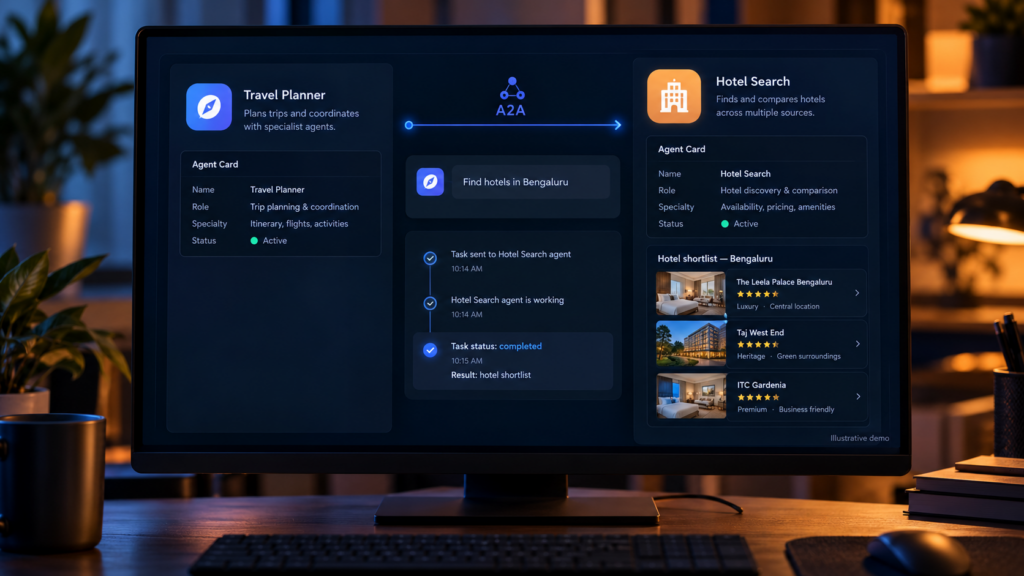
An assistant may understand a request perfectly and still be unable to finish it because another system owns the next step. That problem becomes more visible when a business deploys separate agents for sales, operations and support.
Google announced the Agent2Agent protocol on April 9, 2025 to support communication and coordination across agents built with different technologies. This article examines the original launch rationale, not a new version announcement or a claim about universal adoption.
What A2A set out to standardize
The announcement described a way for agents to advertise capabilities, exchange messages and track tasks through a lifecycle. An Agent Card describes what an agent can do, while task status and outputs help another agent follow the work.
Google positioned A2A as complementary to MCP, rather than a replacement for it. In the launch framing, MCP helps supply tools and context; A2A addresses collaboration between agents.
Why a handoff needs structure
Imagine a sales agent passing an approved onboarding request to an operations agent. A chat message saying “please set this up” leaves important questions unanswered. Which customer is involved? What package was approved? Has payment been confirmed? Who should be notified if setup fails?
For this illustrative workflow, a useful handoff would carry the customer reference, requested outcome, authorized scope, relevant evidence and a task identifier. The receiving system would acknowledge the request and report whether it is waiting, working, blocked or finished.
Those are operational requirements a team should specify even when the communication protocol supplies useful building blocks. A task marked complete is valuable only if the organization agrees on what completion means.
Interoperability does not assign responsibility
Our analysis is that shared communication can reduce integration ambiguity, but it cannot decide who may approve an exception. If the operations agent discovers that the customer’s package is unavailable, the business still needs a rule for substitution or escalation.
The same applies to repeated delivery. If a sender retries after a connection failure, the receiving workflow needs a way to recognize work it has already accepted. Otherwise, better connectivity can make it easier to repeat an unwanted action.
Questions for a vendor demonstration
- Can the receiving agent explain its capabilities and required inputs?
- What happens if the connection drops after an action succeeds?
- Where can a human inspect the task and its final outcome?
- How are permissions checked when work crosses organizational boundaries?
- Can a blocked task return to a named owner with useful context?
The valuable demonstration is a recoverable business handoff. Watching two agents exchange fluent messages is only the beginning.