Google has announced Agent Substrate 1.0, a major milestone for its open-source Kubernetes runtime for stateful AI agents. The project’s final v1.0.0 release is publicly accessible. The runtime separates an agent’s saved working state from the compute resources needed while it is active.
Google’s announcement is dated November 5, 2026. This is a release milestone for Agent Substrate, not a new launch of the managed Agent Compute Engine service. Our earlier Agent Compute Engine coverage explains that separate service and its proposed execution model.
Why agents need infrastructure that can wait
A coding agent might edit a repository, run tests and then wait for a model response or human approval. During that pause, its files and working memory still matter, but continuously reserving an execution environment can consume capacity without advancing the task.
The infrastructure question is how to preserve useful state without dedicating the same compute to every inactive session. Agent Substrate targets that problem. It is an execution layer for tool-using systems, not a new foundation model or a complete replacement for an agent’s orchestration logic.
Actors retain state while workers provide compute
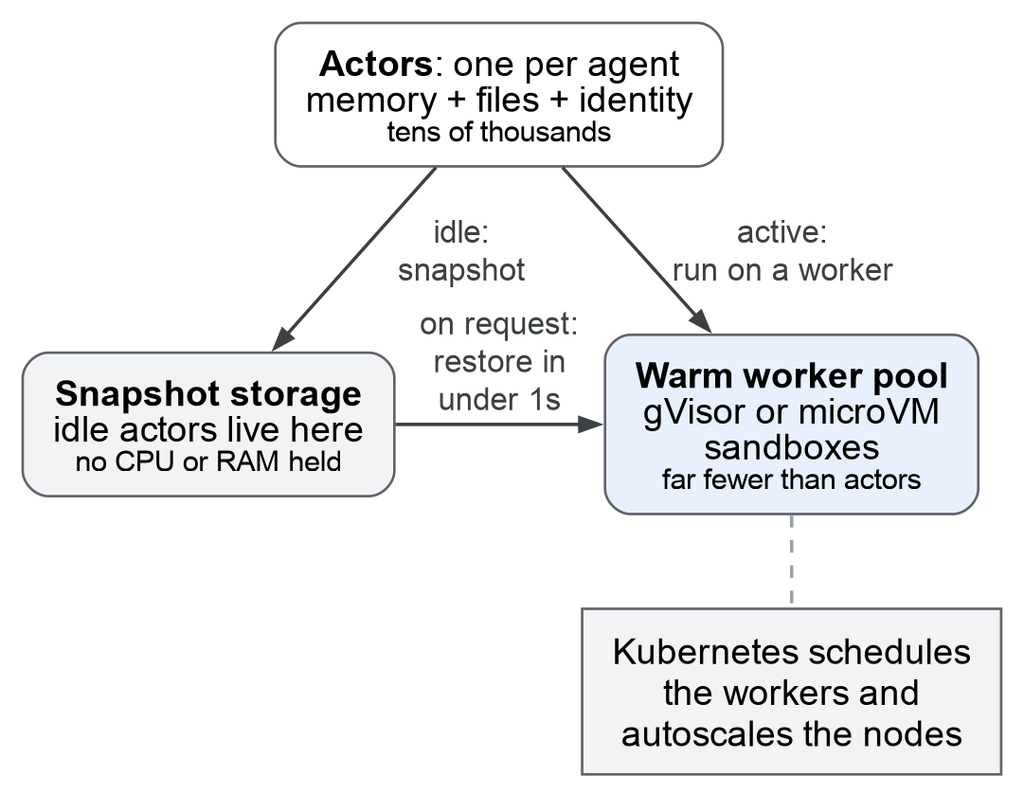
In its November announcement, Google describes Actors holding agent memory, files and identity, with reusable Workers supplying execution sandboxes. When the application requests suspension of an idle agent, the runtime snapshots its working state and releases the Worker. A subsequent request can restore that state onto an available warm Worker. This is application-controlled suspension, not a claim that every waiting agent automatically hibernates.
Google claims restoration in under 500 milliseconds and ten times standard container density. Those are vendor performance claims, not measurements reproduced by AgentsCalling. An operator should not treat them as guaranteed latency or savings for a particular deployment.
The same announcement discusses CNCF Sandbox acceptance and onboarding for Agent Substrate, gVisor and OpenRL. Foundation governance and a 1.0 release are relevant project milestones, but neither should be substituted for workload-specific security and recovery testing.
The deployment limits that change an agent design
Google’s GKE requirements describe an open-source system deployed onto a customer’s own GKE Standard cluster. It should not be confused with a fully managed service that removes cluster operations from the customer’s responsibilities.
| Deployment boundary | Documented requirement or limit | Practical implication |
|---|---|---|
| Cluster support | GKE Standard, version 1.37 or later; Autopilot is unsupported. | Confirm the target cluster before planning installation. |
| GPU access | GPU device passthrough into Actor containers is unsupported; gVisor cannot snapshot live CUDA contexts. | Do not assume a GPU-enabled node gives the agent sandbox a usable GPU. |
| External connections | Open database and MCP-server connections are not preserved during suspension. | Build and test reconnection behavior after resume. |
The connection limitation is particularly important. Preserving a local file or process state is a different guarantee from preserving a usable session with another service. The application still needs to handle the boundary between a restored workspace and an external system.
Additional installation checks: the table is a selected summary, not a complete compatibility checklist. Google also requires Workload Identity Federation for GKE. Its installer enables beta APIs and cannot be used with clusters enrolled in the Extended release channel. Check the current requirements before selecting a cluster or planning an upgrade.
Featured-photo credit: Taylor Vick / Unsplash, used under the Unsplash License. The server-rack photograph is illustrative, not a Google Cloud facility or an Agent Substrate deployment.
General availability and production support need separate checks
The November post describes Agent Substrate as generally available on GKE. However, Google’s separate GKE availability article, dated September 15, continues to state that non-production use is available to all GKE customers while GA production support requires an allowlist.
These statements should not be collapsed into a claim of unrestricted production access. Teams considering a supported deployment should confirm their eligibility and applicable terms with Google. The public 1.0 artifact establishes a release exists; it does not independently establish the support arrangement for every customer.
TechTimes’ November 6 coverage questioned whether a final release was visible. At our November 7 check, the final v1.0.0 release page was accessible. That earlier availability concern should not be repeated as the current repository status.
The useful cost metric is an accepted task
AgentsCalling’s analysis: reducing idle compute is useful only if the resumed workflow still completes correctly. Faster activation can lose its practical value if reconnect failures cause retries, duplicate actions or additional human review.
A fair operating-cost comparison should include the warm Worker pool, snapshot storage, model calls, failed attempts and platform maintenance. The denominator should be tasks accepted under a fixed review standard, rather than the number of sandboxes started. Our AI-agent pricing guide explains why the visible runtime or API charge is only part of that calculation.
A dedicated-Pod baseline may reserve more idle capacity, while a shared-worker design introduces its own operational considerations. Which is preferable depends on workload timing, recovery behavior and total costs. No comparative deployment was run for this article.
A controlled suspend-and-resume test
Proposed evaluation, not performed: run the same synthetic coding workflow on Agent Substrate and a dedicated-Pod baseline. Keep the model, tool permissions, task set and acceptance tests consistent. Introduce predetermined idle periods and record the exact runtime and cluster configuration.
Use a mock database and an owned MCP test service. After resumption, check whether the agent reconnects, recognizes work already committed and avoids repeating an external write. Test both a completed operation and an interrupted operation whose result is initially uncertain. Use synthetic records and credentials only.
Record resume latency, reconnect failures, accepted tasks, duplicate mock writes, human repair time and total infrastructure costs. Our agent action-log design guide provides context for keeping tool requests and their outcomes distinguishable.
A successful demonstration without interruptions would not answer the recovery question. Nor would a low compute bill prove savings if reviewers spent substantially more time repairing the resulting work.
The takeaway: state preservation needs workflow-level proof
Agent Substrate 1.0 gives developers a concrete release to evaluate for long-running agent infrastructure. Its important architectural idea is separating persistent agent state from active compute. The next evidence belongs at the application boundary: whether restored agents reconnect correctly, preserve the intended permissions and complete accepted work at a lower total operating cost.
Reporting note: Prepared with AI-assisted research and drafting on November 7, 2026. Google’s announcement, GKE documentation, availability article, official final release and TechTimes coverage were reviewed. TechTimes published November 6 at 1:15 am EST, equivalent to 11:45 am Asia/Calcutta. Exact Google announcement time was unavailable. Company claims, editorial analysis and the unperformed test are separated above. We did not deploy the runtime, reproduce its performance figures or audit its security.
About Puneet Sharma

Puneet Sharma · Freelance Writer
Puneet Sharma is a freelance writer covering AI agents, automation and the software changing how we work. His coverage at AgentsCalling starts with the questions a reader might ask over a conversation: What does this tool actually do? Where does it fall short? And is it useful beyond the demo? His articles explore new launches, practical workflows and the trade-offs behind giving software more responsibility, with explanations that make room for readers who are still getting familiar with AI.