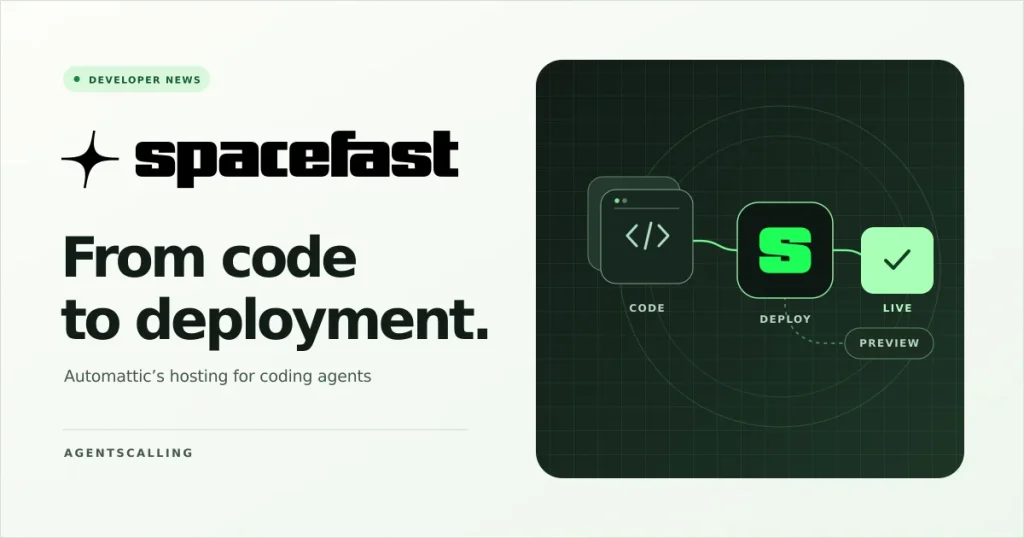
Automattic formally launched Spacefast on 9 November 2026, following a September soft launch reported by TechCrunch. The service lets compatible coding agents deploy websites and apps through the Model Context Protocol (MCP). It is a standalone hosting service, not a WordPress plugin launch.
The shift is practical: an agent that used to hand you a folder of files can now act on a hosting account. That makes it easier to get a working version in front of colleagues. It also means a coding mistake and a deployment mistake no longer have to be separate events.
How an agent deploys to Spacefast
Spacefast’s MCP documentation lists setup guides for Claude Code, Codex and Cursor. The hosted MCP server uses OAuth and takes files supplied by the client. The local MCP server can publish from a workspace folder using the developer’s Spacefast CLI login or a token. In either case, the agent needs publishing permission. A deploy receipt can identify both the live URL and the URL for the exact version created.
In its launch announcement, Automattic says the agent can return a private review link and teammates can comment on the deployed work. The company listed built-in app authentication and transactional email for the following weeks, not as launch-day features. A private review link is not the same as a login system for the app’s users. AgentsCalling has not tested access to those links or benchmarked deployment speed.
Deploying a version and making it live are separate decisions
Spacefast documents an approval flow that can pause an operation before it is sent to the API. If a person approves the request, the agent uses resume_execution to continue the saved operation instead of submitting a new one. That is not a guarantee that every publish requires human review: what an agent can do depends on the access it was granted and the operation it requests.
The versioning documentation also describes a manual promotion policy. A publish can create a ready version without changing what the live URL serves. Promoting a version changes that live pointer; a rollback points it back at an earlier ready version. That documents a way to restore the served version, not a promise to undo database writes or emails already sent.
Our coverage of OpenAI’s Pando Git backend looks at how infrastructure handles more agent-written code. Spacefast raises the next question: who gets to put that code in front of users?
What we would test: a denied release, a retry and a rollback
Use a disposable Space with manual promotion and two builds that visibly say BUILD A and BUILD B. Give the agent access only to the test project and use a configuration that actually puts the requested live action behind approval.
- Serve
BUILD Aat the live URL. Have the agent deployBUILD Bfor private review. Check that the live URL still servesBUILD A. Verify a signed-out browser cannot open the raw URL forBUILD Bwithout access. Then test the actual review link against its configured sharing rule: invited reviewers only, or anyone holding the link. - Have the agent request the live change and decline it. Check the live response and version history. If the action never presents an approval, record that as a configuration finding rather than calling the denial test a pass.
- Approve a fresh request, resume the saved operation, then check the same execution again. Compare the receipts and history: did one live change occur, or did the retry create another release?
- Roll back to
BUILD Aand verify what the live URL serves from a fresh browser session.
This is a proposed test, not a hands-on result. The useful measurement is whether preview, denial, retry and recovery behave as expected when the agent has real deployment access.
Reporting note: Prepared with AI-assisted research and drafting. Automattic’s release and TechCrunch’s coverage were both published on 9 November 2026 at 19:30 IST. Product behavior is attributed to Spacefast’s documentation; AgentsCalling has not independently tested the deployment or approval controls.
About Puneet Sharma

Puneet Sharma · Freelance Writer
Puneet Sharma is a freelance writer covering AI agents, automation and the software changing how we work. His coverage at AgentsCalling starts with the questions a reader might ask over a conversation: What does this tool actually do? Where does it fall short? And is it useful beyond the demo? His articles explore new launches, practical workflows and the trade-offs behind giving software more responsibility, with explanations that make room for readers who are still getting familiar with AI.