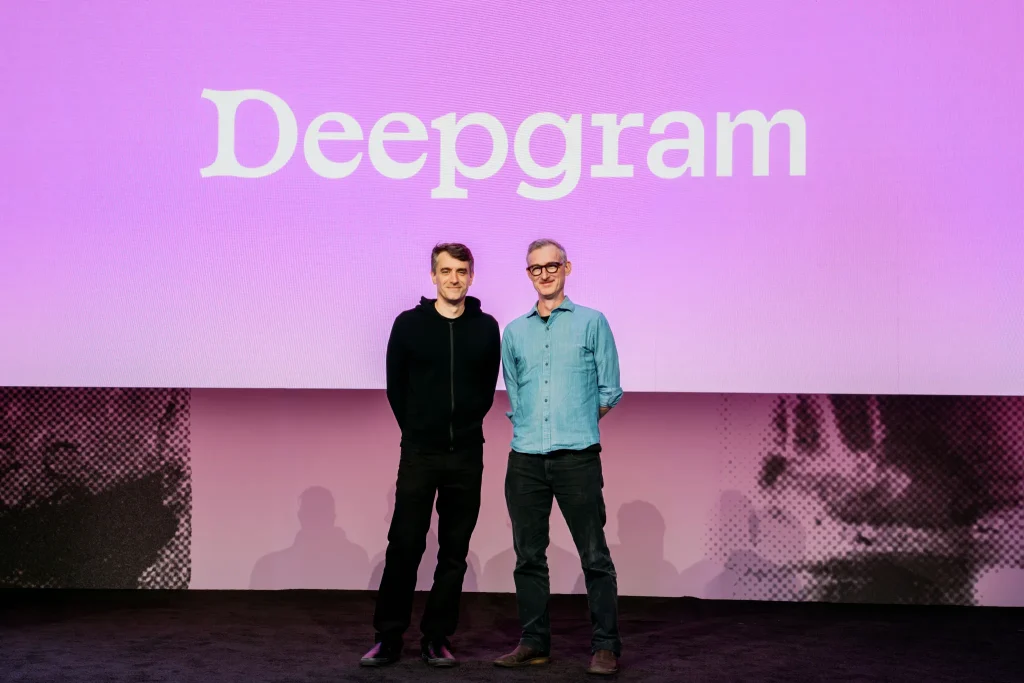
Deepgram announced on 29 October 2026 that it is acquiring Daily, the company behind the Pipecat voice-agent framework and real-time audio and video infrastructure. The companies also plan an independent Pipecat Foundation, putting the framework’s future governance at the centre of the deal.
The reviewed announcements describe an acquisition underway but do not give a closing date. This is follow-up coverage of the announcement, not confirmation that the transaction has completed. The acquisition price was not disclosed.
What the deal brings together
Pipecat is an open-source Python framework for assembling real-time voice and multimodal agents. Its public repository lists speech recognition, language models, speech generation and network transports as separate integrations.
That separation helps explain the business significance. A voice agent needs more than a model that can speak: it needs a connection to the caller, a way to manage the conversation and a pipeline that carries information between services.
Deepgram says Pipecat and Daily’s infrastructure will underpin its new Voice Agent Platform alongside its speech models. It identifies Daily co-founder Kwindla Hultman Kramer as its new head of open source. This is a move towards a broader infrastructure stack, rather than simply another speech-model release.
The acquisition announcement describes the platform as forthcoming and says a preview is planned at the company’s Speak event. That wording should not be treated as proof of general availability; individual product releases require their own availability checks.
Customer continuity is a company commitment
In Daily’s announcement, Kramer says Deepgram will sell, support and develop Daily’s existing products and services, while the team continues work on Pipecat and its communications infrastructure.
That is an important commitment for customers. It is not an independently measured guarantee about future pricing, support response times, contract terms or service quality.
For a team already running calls, the immediate review should be specific to its deployment: which services it buys, which credentials it uses and which commercial terms apply. The announcement alone does not establish that a customer must migrate its application, nor that every operational detail will remain unchanged indefinitely.
An open license and independent governance are different things
Deepgram says Pipecat will remain open source and vendor-neutral. Daily says the proposed foundation will have a steering committee representing the wider real-time AI ecosystem, including Deepgram competitors.
Pipecat’s repository currently identifies the project’s license as BSD-2-Clause. That is verifiable evidence about the code’s present licensing, not proof that the foundation is already operating independently.
The material reviewed does not establish the foundation’s final voting rules, appointed membership or control over releases. Those details matter because an open repository and a neutral decision-making process answer different questions.
AgentsCalling’s analysis: builders should look for who can approve changes, how competing providers gain representation and whether contributors can challenge decisions. A promise of neutrality becomes more useful when it is backed by a published process.
Switching models is not the same as switching infrastructure
The repository lists non-Deepgram speech providers and transports including Daily, LiveKit and SmallWebRTC. That supports the existence of multiple integration paths. It does not demonstrate that every provider combination has identical features or can be exchanged without application changes.
The transport documentation makes the distinction concrete. DailyTransport connects a pipeline to Daily’s hosted WebRTC service and requires Daily account and room setup. LiveKitTransport uses a different server, credentials and room-authentication configuration, with self-hosted or cloud options.
Changing the speech model therefore need not remove a team’s dependence on its network provider. Changing the network provider may involve a separate migration.
For buyers, our analysis is that portability should be measured at the workflow level. A replacement that produces clear audio but loses interruption handling, duplicates a tool action or fails a handoff is not equivalent in practice.
Our coverage of Monday.com’s Harmony voice agents examines why human handoffs and accurate records matter alongside response speed. The same outcome-focused questions apply when evaluating infrastructure beneath a calling application.
Pipecat supports alternative providers, but the development effort and changes to the calling experience will depend on each deployment.
Deepgram’s proposed acquisition could make a complete voice-agent stack easier to assemble. The business question is whether that convenience arrives with durable choice, both in the code developers can use and in the infrastructure they can realistically leave.
About Puneet Sharma

Puneet Sharma · Freelance Writer
Puneet Sharma is a freelance writer covering AI agents, automation and the software changing how we work. His coverage at AgentsCalling starts with the questions a reader might ask over a conversation: What does this tool actually do? Where does it fall short? And is it useful beyond the demo? His articles explore new launches, practical workflows and the trade-offs behind giving software more responsibility, with explanations that make room for readers who are still getting familiar with AI.