Apple plans to add Model Context Protocol access to Pages, Keynote and Numbers through its November 2026 Creator Studio update, giving external AI agents a way to work directly inside the three productivity apps. Announced on October 27, the integration will require macOS 27 or later. Apple has not specified a release day within November.
According to Apple’s announcement, connected agents and tools will be able to read content, make edits and carry out automated actions. The announcement establishes planned capabilities, not independently tested performance or confirmed general availability today.
Why MCP access matters beyond a chat assistant
MCP standardizes how AI applications connect to external tools and data. As our MCP explainer describes, connecting a tool is only the first step in building a useful agent workflow.
The practical opportunity here is document work that remains inside the application. A possible workflow would turn approved research into a Pages brief, use checked figures in Numbers and prepare a Keynote presentation. That is an illustrative use case, not a cross-app workflow Apple has demonstrated or AgentsCalling has tested.
Tool access is also different from agents handing tasks to one another. Our MCP versus A2A guide explains that distinction. Apple’s announcement concerns access to applications, not a new multi-agent coordination protocol.
The built-in assistants are a separate feature
MacRumors’ coverage corroborates the Mac-only MCP requirement and distinguishes it from the new in-app assistants. Those assistants are beta features for Apple Intelligence-capable devices running iOS 27, iPadOS 27 or macOS 27 and later, with U.S. English support.
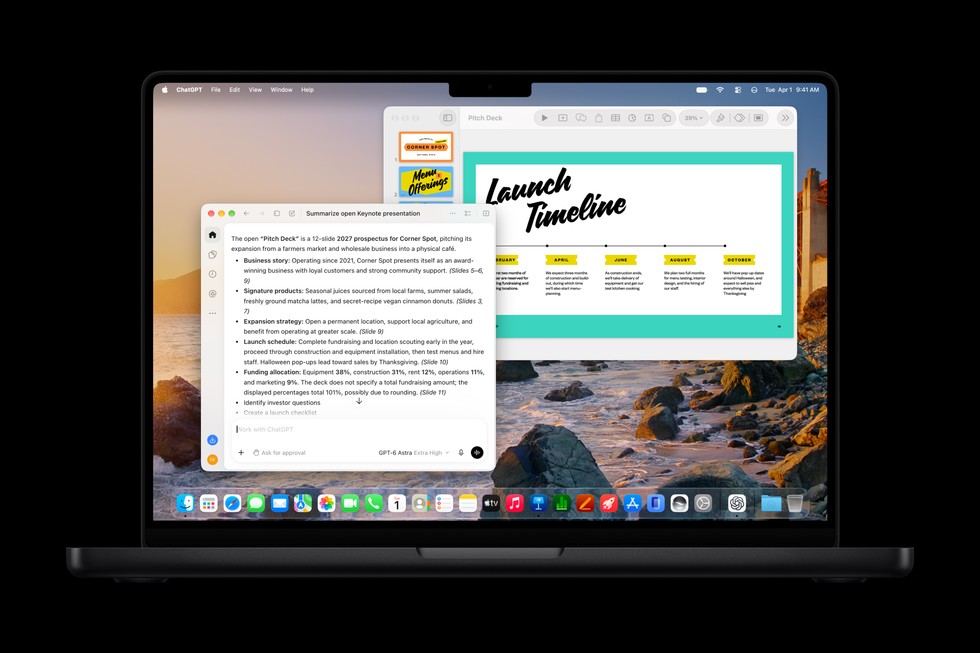
Apple says the built-in assistants combine Apple models with OpenAI technology. Their roles include drafting and restructuring text in Pages, helping refine presentations in Keynote, and calculating or organizing information in Numbers. That does not establish that an external MCP agent uses the same models, runs entirely on-device or receives identical permissions.
Keynote also gets a tool-readable format
Apple separately announced Keynote Interchange Format, or .keyx, an open JSON-based bundle intended for external tools, developers and agents. This is distinct from MCP: a file format describes stored presentation content, while a protocol connection provides a way to interact with an application. Apple did not announce equivalent new interchange formats for Pages or Numbers in this release.
The important unknown is what an agent is allowed to change
For teams considering document automation, the useful evaluation is not simply whether an agent can edit a file. It is whether the agent edits the intended file, stays within the approved task and leaves changes that a person can inspect.
The announcement does not detail per-action approval prompts, read-only versus editing scopes, administrator policies or audit-log coverage. Those omissions are unanswered implementation questions, not evidence that the controls are absent. Compatibility with particular third-party clients also needs confirmation.
A connection standard should not be treated as a blanket safety guarantee. An apparently successful spreadsheet edit could still change a formula incorrectly, and a polished slide could still misrepresent its source data. Human review needs to examine the underlying change, not only its appearance.
Availability and what to check after release
Apple and MacRumors place the broader Creator Studio update in November, with no additional update charge for existing subscribers. Apple also says the free versions of Pages, Keynote and Numbers remain available. The announcement does not clearly establish whether every MCP capability will be accessible without a Creator Studio subscription, so that should be verified before purchase or deployment.
After release, AgentsCalling’s proposed test would use synthetic documents to compare reading and editing access, inspect formula changes, attempt an out-of-scope edit and revoke the connection mid-task. The test would check whether later tool calls stop and whether reviewers can reconstruct the changes. No such testing has been performed.
The significant development is Apple opening native productivity apps to external agent workflows. Whether that becomes dependable everyday automation will depend on the released tools, compatibility and permission boundaries, not the presence of an MCP label alone.