Google has opened a preview of Gemini for government services, a package of AI skills, software connections and partner agents intended to help U.S. agencies review procurement documents, interpret regulations and prepare public records for disclosure.
Announced on October 20 at Google Public Sector Summit, the offering targets federal, state and local governments. Google’s official announcement names the State of Missouri and the U.S. Department of Health and Human Services among early users.
The rollout is still limited. Nextgov/FCW reported that Google is seeking more early adopters, with general availability expected later in 2026 but no fixed date. Google Public Sector field CTO Chris Hein told the publication that some partner agents are available, while most are not yet.
For agencies considering the preview, the central question is how much document preparation an agent can reliably take on while keeping decisions traceable to the evidence and the officials responsible.
What Google is packaging for agencies
Google describes skills as reusable instructions and context written by domain experts. They give the agent a defined way to approach a task, incorporating the regulations and agency guidance relevant to that work.
The package also connects to existing software, including Google Workspace, Microsoft SharePoint, Salesforce and ServiceNow, alongside regulatory information sources. Google says existing identity and access controls carry into those integrations.
That combination matters because a procurement or records request rarely lives in one document. An analyst may need a policy, an attachment, a supplier submission and a record from another system before reaching a useful answer.
Connecting those sources could reduce the work of finding and assembling evidence. Whether it reduces the total workload depends on how much checking and correction the resulting output needs.
Procurement support puts the evidence behind a score in focus
Google says the procurement tools can compare bids with solicitation requirements and acquisition rules, identify qualification gaps and help produce scoring and decision justifications.
The useful distinction is between preparing an assessment and authorising an award. A convincing explanation can still rest on an incomplete document or a misread requirement.
Consider a hypothetical bid review. One supplier includes a required certificate in an appendix; another says the certificate will follow later. A useful assistant would show where the evidence appears, identify what is missing and preserve the distinction between the two submissions. Treating both as compliant would undermine the review, even if the generated summary reads smoothly.
An agency evaluating the tool should therefore examine whether every material finding can be traced to the correct document and requirement. Reviewers also need a practical way to challenge the analysis without losing the original evidence.
Public records work needs reviewable redactions
Freedom of Information Act work and document redaction are also part of Google’s planned government workflows. In its separate product explanation, Google describes proposed redactions paired with statutory exemptions and a reviewer confirmation step before redacted copies are exported.
That design places human review at a consequential point: deciding what information leaves the agency.
For an evaluation, both missed and excessive redactions matter. Failing to remove sensitive information could expose it. Removing too much could leave a document unnecessarily incomplete. Measuring only the speed of processing would miss both problems.
A useful trial would give reviewers a known set of sample documents and ask whether they can find, understand and correct the agent’s proposed changes. The exported file should also be checked, rather than assuming that a black box displayed over text proves the underlying content is gone.
IT leadership controls which agents are enabled
Nextgov’s interview adds an operational detail: Google will prescreen partner agents, and agency IT leadership will decide which ones to enable. Individual employees will not make that deployment decision themselves.
Approval to make an agent available is only one part of the control model. Agencies still need to decide which records it may read, which systems it may change and when a person must approve an action.
The same permissions question runs through our coverage of Microsoft’s Guardian Agents. For a government workflow, the relevant boundary may sit between reading a case file, preparing a recommendation and releasing the final record.
What the preview needs to demonstrate
A practical pilot could use synthetic procurement files and public-records requests, with separate user roles and deliberately restricted attachments. That would let an agency examine citation accuracy, access boundaries, review effort and the handling of missing evidence without relying on sensitive live cases.
Success should include the time needed to review and repair the output. An agent that produces a draft quickly but leaves extensive checking behind may shift work rather than reduce it.
The next useful evidence from this preview will be how reliably agencies can complete those workflows, correct mistakes and retain a clear record of who approved the outcome.
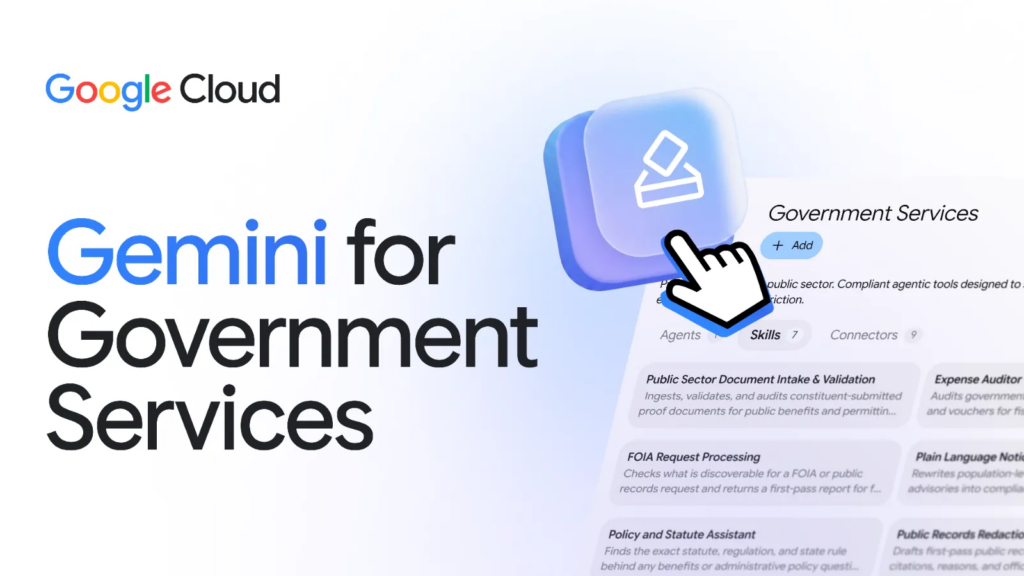
Featured image: Google Cloud official Gemini for government services announcement graphic. Image credit: Google Cloud.
About Puneet Sharma

Puneet Sharma · Freelance Writer
Puneet Sharma is a freelance writer covering AI agents, automation and the software changing how we work. His coverage at AgentsCalling starts with the questions a reader might ask over a conversation: What does this tool actually do? Where does it fall short? And is it useful beyond the demo? His articles explore new launches, practical workflows and the trade-offs behind giving software more responsibility, with explanations that make room for readers who are still getting familiar with AI.