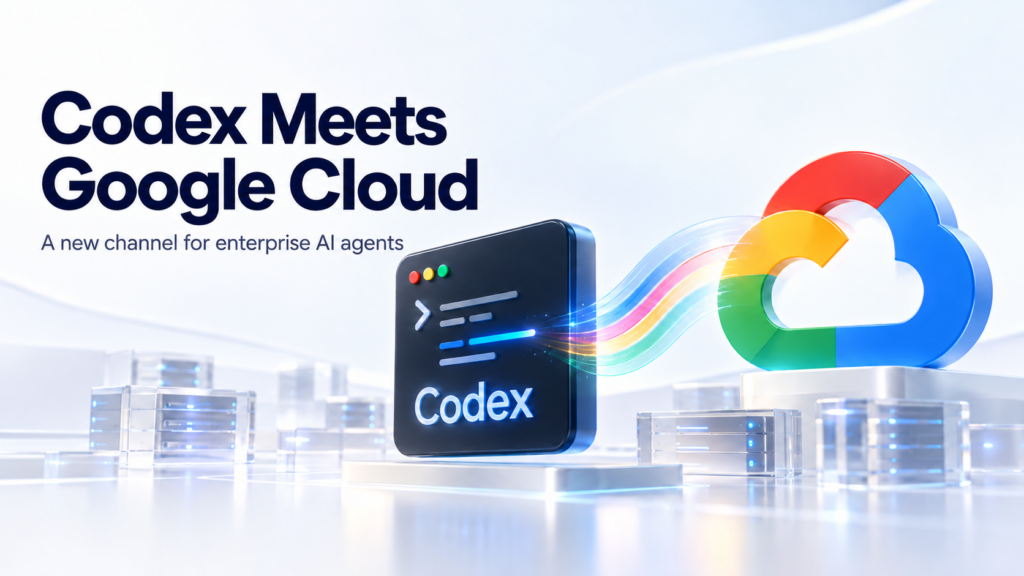
OpenAI is expanding Codex and its frontier models to Google Cloud, giving enterprise customers another route to buy and use AI through a cloud provider they already work with. Announced on 21 October, the partnership puts two AI competitors on the same side of an enterprise distribution deal.
Availability needs a qualification. Google says private preview is rolling out to selected enterprise customers. OpenAI says general availability is planned in the coming weeks. The announcement does not mean every Google Cloud customer can turn on the full offering today.
What the Google Cloud agreement changes
According to OpenAI’s announcement, customers will access its models through Model Garden and purchase them through Google Cloud Marketplace. Enterprises will be able to apply existing Google Cloud spending commitments to those purchases.
OpenAI also says its models will reach Google Antigravity and Gemini Agent. Those integrations are described as forthcoming. Microsoft remains OpenAI’s primary cloud partner.
Google’s announcement adds a practical detail about the initial preview: participating customers can connect local Codex CLI and Desktop workflows to Google’s Gemini platform for inference, the process of generating a model response.
That distinction matters. A developer working in a local Codex application can use a different service to supply the model’s responses. This should not be read as confirmation that every Codex feature or execution environment has moved to Google Cloud.
Why the purchasing route matters
For enterprise buyers, access to an agent involves more than choosing a model. Someone must approve the supplier, assign a budget, manage credentials and decide which business data the system can use.
The ability to draw down an existing cloud commitment could make the purchasing step easier. A company that has already committed money to Google Cloud may have a clearer budget route for evaluating OpenAI than one that needs a separate purchasing agreement.
That is a potential reduction in procurement friction, not proof of lower operating costs. A cloud commitment is still a spending obligation. Buyers need to compare the actual bill for a completed task, including retries, tool execution and human review.
A useful evaluation would give competing configurations the same bounded task, such as preparing a patch and tests for an internal application. The comparison should measure whether the patch works, how much review it needs and what the complete run costs. Convenient billing alone cannot answer those questions.
Cloud competitors can also sell each other’s agents
OpenAI’s Google agreement follows its April announcement of models, Codex and managed-agent capabilities on AWS in limited preview. That earlier arrangement also connected agent adoption to customers’ existing cloud infrastructure and purchasing processes.
Reuters and Axios both reported the new Google agreement on 21 October, placing it within OpenAI’s expansion across major cloud providers.
The commercial implication is that a cloud company can compete to build the preferred model while also selling access to a rival’s technology. For Google, offering another supplier’s models could help retain workloads from customers who want that supplier. For OpenAI, distribution through an established cloud relationship could widen the pool of enterprise buyers.
Those are incentives created by the arrangement, not reported revenue outcomes. The deal does not establish how many customers will adopt Codex through Google or whether they will use it instead of, or alongside, competing agents.
Cloud governance still needs workflow controls
The companies describe Google Cloud access controls and data governance as part of the offering. Those controls address an important enterprise requirement, but buyers still need to decide what an agent is allowed to do after it receives a task.
Permission to request a model response is different from permission to modify a repository, use a production credential or deploy a change. An evaluation should examine each of those permissions separately and establish who reviews consequential actions.
The distinction connects with OpenAI’s disclosure about coding agents weakening internal safety monitoring. That separate story raises questions about protecting oversight mechanisms when agents can edit software. It is not evidence of a flaw in this Google Cloud integration.
For a team considering the preview, the immediate questions are concrete: Is the required workflow supported? Which data and logs are retained? Which region and contractual terms apply? What requires human approval? And can the team attribute the cost and outcome of each run?
What enterprise buyers should watch next
The next useful milestone is broader availability with clear service terms and support for the workflows customers actually need. Until then, the announcement establishes a new distribution route, with access initially limited.
The larger change is commercial: choosing an AI supplier and choosing a cloud provider are becoming more separable decisions. For buyers, that could create more room to compare agents within an existing operating environment. The value will depend on whether that choice translates into reliable work at an acceptable total cost.
Prepared with AI-assisted research and drafting.
About Puneet Sharma

Puneet Sharma · Freelance Writer
Puneet Sharma is a freelance writer covering AI agents, automation and the software changing how we work. His coverage at AgentsCalling starts with the questions a reader might ask over a conversation: What does this tool actually do? Where does it fall short? And is it useful beyond the demo? His articles explore new launches, practical workflows and the trade-offs behind giving software more responsibility, with explanations that make room for readers who are still getting familiar with AI.