GitHub has made Copilot Fusion and GitHub Agentic Workflows generally available, extending its agent tooling from model selection to repeatable repository operations.
Both releases were announced on 28 October 2026. They solve different problems: Fusion decides which models should handle a task, while Agentic Workflows defines when an agent runs in GitHub Actions and what it is permitted to do. Neither announcement means a team should hand over unrestricted control of its repositories.
Fusion is a routing system, not a new model
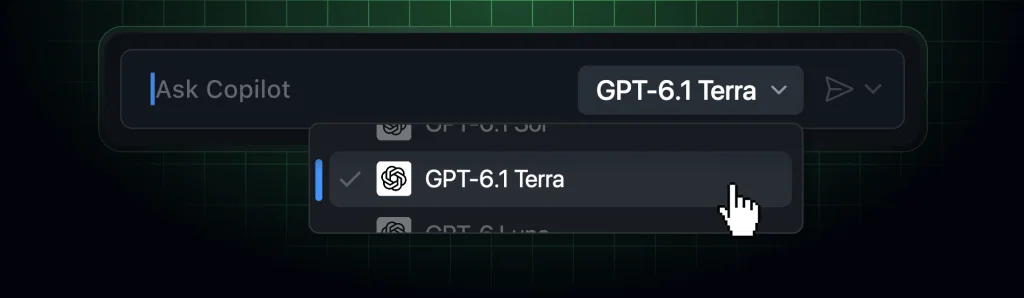
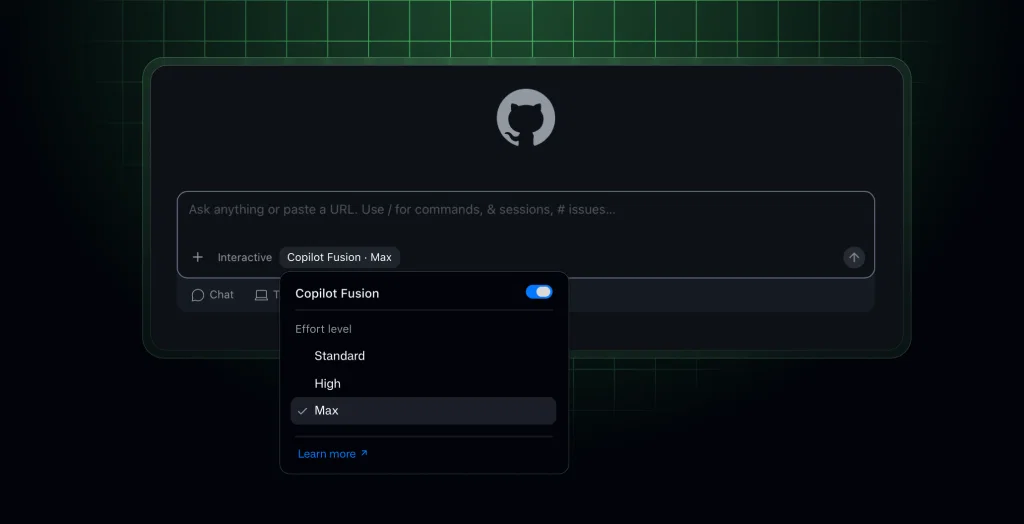
Copilot Fusion combines the earlier HydraFusion research preview with automatic model selection. Developers choose an effort level rather than manually selecting every underlying model. GitHub lists availability across Copilot plans in VS Code, Copilot CLI, the Copilot app and JetBrains IDEs.
Its execution patterns range from a single model completing a request to a cascade that escalates a draft after a quality check. In a critique pattern, a draft is reviewed and revised. More model calls are therefore possible, but not required for every prompt.
Administrators can restrict the eligible model pool through organization and enterprise policies. Availability across Copilot plans should not be read as access to every model or identical capabilities under every subscription.
Independent benchmarks support a narrower cost claim
An Artificial Analysis evaluation, also published on 28 October, tested Fusion Max through Copilot CLI. Its Coding Agent Index result was two points below Claude Code with Opus 5.5 Max, at an average cost of $5.59 per task versus $11.42.
That is independent benchmark evidence, not simply a GitHub savings claim. But performance varied: Fusion scored 71 on Terminal-Bench 4.0 and 51 on FrontierCode, where the compared Claude Code configuration scored 56. A close aggregate score does not establish that Fusion is equally capable on every workload.
GitHub also cites approximately 40% less time per task. The reviewed Artificial Analysis article does not supply the completion-time figures needed to independently check that particular claim. AgentsCalling has not reproduced either system’s performance.
Model costs and workflow costs remain separate
Fusion bills for the underlying models it uses, without a separate Fusion charge, according to GitHub’s documentation. Paid Copilot plans receive a temporary 30% model-cost discount through 30 November 2026. That promotion is separate from the benchmark comparison.
Agentic Workflows is free and open source, but execution is not automatically free. Its FAQ separates AI-engine charges or Copilot quota from Actions compute usage. Teams should estimate the cost of recurring runs, not just one successful demonstration.
Our coverage of Salesforce’s agent spending controls examines the related distinction between measuring agent consumption and enforcing a budget. Lower average task costs do not remove the need for spending limits.
Agentic Workflows brings agents into GitHub Actions
The separate Agentic Workflows release lets teams describe reasoning-based automations in Markdown, which is compiled into Actions YAML. Examples include issue triage, CI investigation, documentation updates and test writing. Existing runner groups and policy constraints still apply.
GitHub says the release is available on github.com for Free, Team and Enterprise accounts. The default Copilot CLI engine requires a Copilot license; developers can instead configure another supported coding engine. Fusion and Agentic Workflows should not be treated as one inseparable product or a requirement to use the same model setup everywhere.
Read-only agents can still lead to automated writes
GitHub documents read-only defaults, sandboxing, network controls and checks on proposed changes. Its safe-output architecture separates the agent’s structured action requests from permission-controlled jobs that execute allowed operations.
This distinction matters: read-only agent permissions do not mean the complete workflow cannot write. Configured output jobs may create issues, publish comments or perform other operations automatically. Review requirements depend on the selected outputs and policy gates, not a universal approval prompt.
The AWS MCP authorization incident concerned a different implementation, not GitHub. It nevertheless illustrates why an agent’s downstream credentials and permissions deserve scrutiny separately from its visible instructions.
Fusion has another documented limitation: discarding a model’s draft does not automatically undo workspace edits that draft already made. Developers still need to inspect changes before committing them. Model review is not the same thing as transactional rollback.
The useful test is accepted work, not generated activity
AgentsCalling’s analysis is that these releases make two operational choices more explicit: how model work is allocated, and how recurring agent work reaches a repository. The value depends on whether the resulting changes are correct, affordable and authorized.
Our proposed evaluation would run the same disposable-repository tasks with a fixed model and Fusion. It would record inference and runner costs, successful tests, accepted changes and human rework. Separate workflow checks would attempt an undeclared write and an action requiring approval, then inspect whether both remain blocked under the configured policy.
No such testing has been performed by AgentsCalling. GitHub’s Universe announcement establishes the broader product direction; production reliability still needs evidence from the team’s own tasks, permissions and review process.
About Puneet Sharma

Puneet Sharma · Freelance Writer
Puneet Sharma is a freelance writer covering AI agents, automation and the software changing how we work. His coverage at AgentsCalling starts with the questions a reader might ask over a conversation: What does this tool actually do? Where does it fall short? And is it useful beyond the demo? His articles explore new launches, practical workflows and the trade-offs behind giving software more responsibility, with explanations that make room for readers who are still getting familiar with AI.