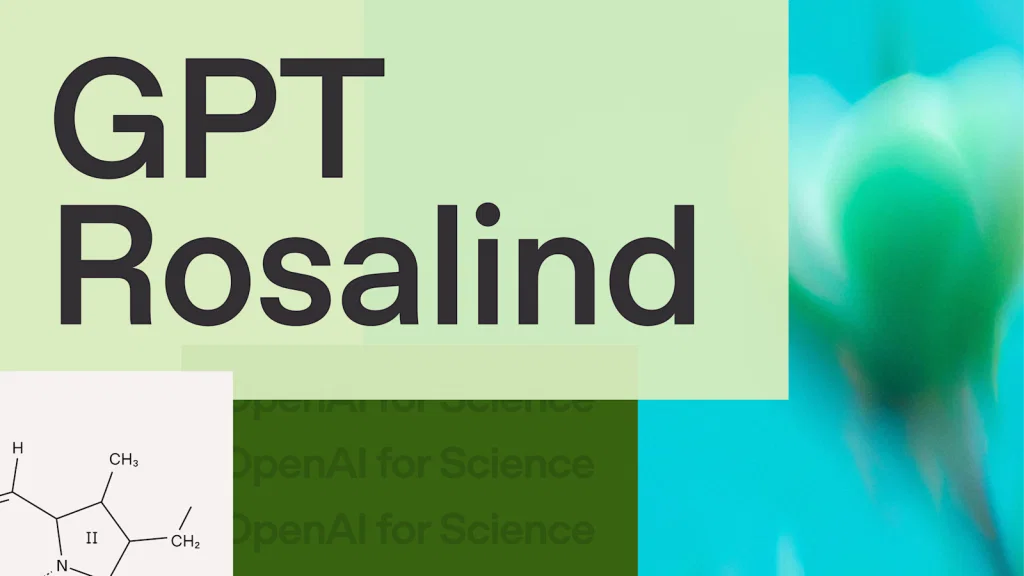
OpenAI released GPT-6 Rosalind on 30 October 2026 for approved internal life-sciences research. The release brings a new option to teams building workflows around scientific tools and data, rather than a model that any developer can immediately add to a public application.
The distinction matters. OpenAI’s access documentation limits GPT-6 Rosalind Research to approved Research organizations and authorized users in Work and Codex, with separate approval required for API access. It is not available in the Chat tab.
This is an update to an existing product family. OpenAI introduced GPT-Rosalind on 16 April and announced its exit from research preview for eligible trusted-access organizations in September. The 30 October release should not be confused with those earlier milestones.
Scientific tool use is the agent connection
OpenAI describes Rosalind as supporting research that combines published evidence, biological data and specialist tools. Its stated uses include literature synthesis, genomics analysis and experimental planning.
That is the relevant agent connection: the model can participate in a sequence of tool-assisted steps, rather than only produce a conversational answer. For example, a research workflow might gather papers, run an analysis on an approved dataset and assemble an explanation of the results. That example illustrates the workflow, not a measured outcome from this release.
The surrounding software also matters. A useful research agent needs to retain the source of an observation, the code used for an analysis and the assumptions behind a conclusion. A plausible final report does not establish that those intermediate steps were correct.
Our coverage of OpenAI’s Orchestra Bio acquisition explains a separate part of that effort: coordinating studies and dependencies around drug development. A research model and a program-management agent have different responsibilities. This release does not, by itself, establish a new integration between them.
Research approval is not a general subscription benefit
Approval for Rosalind Discovery does not grant GPT-6 Rosalind Research access. Existing GPT-5.5 Rosalind Research remains selectable for approved workflows.
Enterprise workspaces start with a two-week Admin Preview, during which the new model is off by default. Administrators can enable it for approved Research users.
API access is restricted to approved internal research tools and applications. Customer-facing products and external commercial applications are outside that scope. A team planning a public scientific assistant therefore cannot treat an API model identifier as permission to launch one.
The new model has higher published token rates
OpenAI’s Standard short-context prices show a substantial difference from the existing Rosalind Research model.
| API model | Input | Cached input | Output |
|---|---|---|---|
| gpt-6-rosalind | $15.00 | $1.50 | $75.00 |
| gpt-rosalind-research | $5.00 | $0.50 | $25.00 |
The new model’s listed rates are three times higher across those categories. Longer-context rates and cache-write charges need separate checking against the current rate card.
As a simple illustration, a workload totaling one million uncached input tokens and 100,000 output tokens across requests billed at the short-context rates would cost $22.50, compared with $7.50 at the existing Research model’s rates. This is token arithmetic, not a measured research-task cost; it excludes other services and charges.
For agents that repeat searches, rerun code or revise an answer, the useful comparison is cost per accepted result. A higher rate could still be economical if fewer attempts and corrections are needed, but that requires workflow-level evidence.
Same Astra weights with a different deployment boundary
OpenAI’s system-card addendum says GPT-Rosalind-6 uses the same weights as GPT-6 Astra, without added training data or additional post-training for this release.
It should therefore not be described as a newly trained biology foundation model. The company describes a trusted-access deployment that permits more legitimate advanced biological work, including some dual-use queries, while retaining boundaries against harmful uses.
OpenAI requires qualified human review before outputs inform experiments, publications or consequential decisions. Those requirements remain relevant even when the system can operate tools.
The system card is a company assessment, not independent validation of autonomous scientific reliability. The release and access documents do not establish that the model produces better real-world scientific outcomes than an existing research team’s workflow.
What changes for scientific-agent builders
AgentsCalling’s analysis is that this release expands the model choice inside an already controlled research environment. It does not remove the need to validate sources, inspect analyses or assign responsibility for consequential decisions.
For an eligible lab, the practical question is whether the new model produces results that survive expert review with less rework, at an acceptable total cost. Access approval, tool permissions and the evidence behind each conclusion remain part of that evaluation.
About Puneet Sharma

Puneet Sharma · Freelance Writer
Puneet Sharma is a freelance writer covering AI agents, automation and the software changing how we work. His coverage at AgentsCalling starts with the questions a reader might ask over a conversation: What does this tool actually do? Where does it fall short? And is it useful beyond the demo? His articles explore new launches, practical workflows and the trade-offs behind giving software more responsibility, with explanations that make room for readers who are still getting familiar with AI.