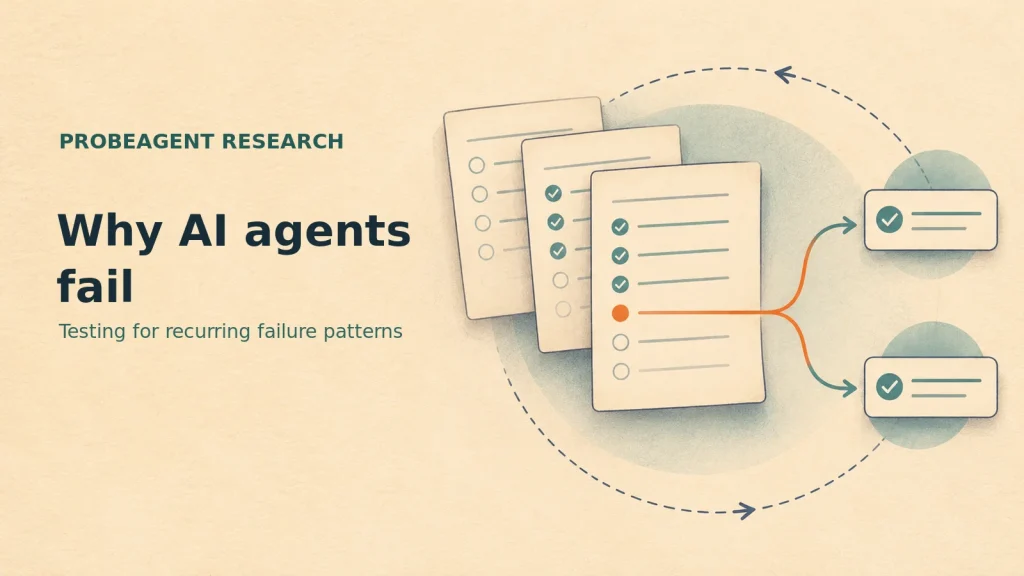
A coding agent can finish its calculations and still fail a task by never saving the requested file. Another agent can try to save the file and get blocked by the environment. Both receive the same failing grade, but they need different fixes. ProbeAgent, a research framework described in an arXiv preprint, turns that distinction into a test developers can repeat.
The work by Yue Huang and colleagues was submitted on November 19 and appeared in the November 23 paper listings. In the preprint, the authors report collecting 1,244 explained failures and producing 536 descriptions of failure modes across 22 agent configurations and tasks drawn from 10 benchmarks. These numbers describe the researchers’ collection, not failure rates for general-purpose agents in production.
How ProbeAgent checks a proposed cause
A sample test combines an environment, an instruction, a reference solution and a checker. The reference establishes that the task can be completed. The checker looks for the resulting state rather than judging the final message alone. The framework also reviews whether the checker accepts the work the instructions actually request. A checker that accepts an empty report, for example, would make an evaluation of report-writing agents misleading.
When a run fails, the framework proposes an explanation from the sequence of actions. It then generates related tasks that keep the suspected cause but change other details, such as the data or the required output. If the same behavior recurs, developers have more reason to investigate it as a pattern. The project documentation describes how related failures are grouped and how each description is tied to execution records.
What the research did and did not prove
The authors say 119 of 239 proposed explanations reached these follow-up tests within the study’s budget. Of those tested, 48 did not recur in any related task and 20 met the paper’s criterion for recurring agent behavior. The remaining tested cases showed weaker recurrence or had too few follow-up tasks to meet the threshold. Not reproducing a mistake under those conditions does not prove it cannot happen elsewhere.
Two human annotators assessed descriptions for 30 failures. Across the reviewers, 90% of assigned descriptions were accepted, and 83.3% of closely related alternatives were correctly rejected. That checks whether sampled labels fit the failures. It does not establish how accurately the system can predict new failures on unseen production workloads. The benchmark replay also used a small, selected set, so it should not be treated as a general ranking of models. Our coverage of GitHub’s Fusion evaluation shows why an aggregate result can hide differences between workloads.
A practical test for a team shipping an agent
Give an agent read-only access to three small synthetic datasets and permission to write only in an isolated output folder. Keep the completion requirement fixed but change the file type or folder layout. Score whether the artifact exists, whether it contains the required result and whether the tool log records an attempted write. If an agent repeatedly claims success without an artifact, compare an explicit final output check with a change to the prompt.
A final status message is an instruction-level signal. A saved file is evidence of execution. Checking both helps teams see whether the next change belongs in the prompt, the tool integration or the application enforcing the workflow. The drill above is proposed, not an account of testing performed for this article.
Research verified November 24, 2026. This is a preprint and its results are author-reported. The documentation loaded, but the code repository linked from the paper returned 404 in the web reader, so installation and reproducibility were not verified.
About Puneet Sharma

Puneet Sharma · Freelance Writer
Puneet Sharma is a freelance writer covering AI agents, automation and the software changing how we work. His coverage at AgentsCalling starts with the questions a reader might ask over a conversation: What does this tool actually do? Where does it fall short? And is it useful beyond the demo? His articles explore new launches, practical workflows and the trade-offs behind giving software more responsibility, with explanations that make room for readers who are still getting familiar with AI.