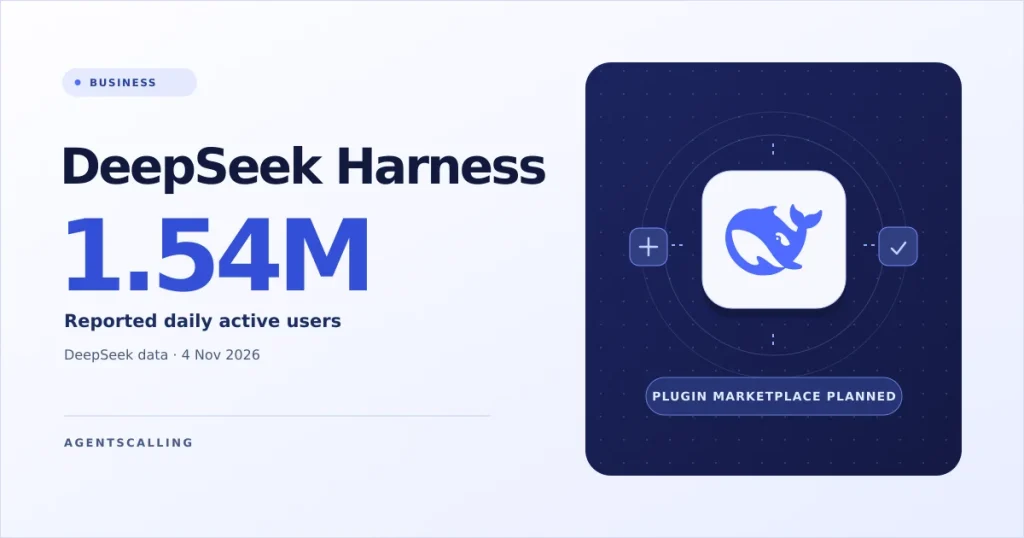
DeepSeek says Harness reached 1.54 million daily active users on 4 November 2026, counting only users who accessed it through the company’s official API. The team also reported roughly 35,000 third-party plugins and outlined plans for an official marketplace and a support program for plugin authors.
IT Home covered the product update on 5 November. DeepSeek Harness shared the figures in an 8 November X disclosure, which Bloomberg reported via The Business Times on 9 November at 14:00 IST. These are separate publication dates, not separate adoption milestones. The usage and plugin counts have not been independently audited.
What exists today, and what DeepSeek is planning
The official GitHub repository describes Harness as an open-source agent application built around plugins. Its code is public under the MIT license, and the repository labels the project a developer preview and warns that interfaces may change. Harness already has a plugin installation flow. An official marketplace would add a central place for authors to publish and users to discover extensions.
The Harness team says it is preparing token grants, technical discussions and promotion for plugin authors, alongside work on plugin security and API compatibility. The marketplace is not live, and the disclosure did not specify a launch date, grant eligibility or an approval process for listings.
A distribution channel is only as useful as its plugins
If the adoption figure is broadly accurate, Harness could give independent developers a meaningful audience for specialized tools without requiring them to build their own agent interface. But 35,000 plugins is a count, not a quality measure. It does not tell developers how many extensions are actively maintained, how often users keep them installed, or how reliably they work after an update.
For users, discovery and trust are separate problems. A marketplace can make an extension easy to find without answering what it can read, which actions it can take or what access survives removal. DeepSeek’s safety notice warns that Harness can run code and reach resources made available to it, and that its controls should not be the sole protection for untrusted workloads. Our coverage of persistent agent permissions explains why granting access and checking that it ended are separate steps.
The test: does uninstall actually end access?
In a disposable Harness environment, install a small, reviewed test plugin that can read one synthetic file and call a local mock service. Before enabling it, record what the installer tells you about file and network access. Run one allowed call and one out-of-scope call, then disable and uninstall the plugin. Restart Harness and repeat the attempts while checking the mock service’s logs. If a credential was issued, test revocation separately; removing an extension from a menu does not prove its credential stopped working.
Reporting note: Prepared with AI-assisted research and drafting. The original X post did not load directly during verification; the disclosure was checked against an accessible archive, Chinese reporting and Bloomberg’s syndicated article. AgentsCalling has not independently audited the figures or performed the proposed test.
About Puneet Sharma

Puneet Sharma · Freelance Writer
Puneet Sharma is a freelance writer covering AI agents, automation and the software changing how we work. His coverage at AgentsCalling starts with the questions a reader might ask over a conversation: What does this tool actually do? Where does it fall short? And is it useful beyond the demo? His articles explore new launches, practical workflows and the trade-offs behind giving software more responsibility, with explanations that make room for readers who are still getting familiar with AI.