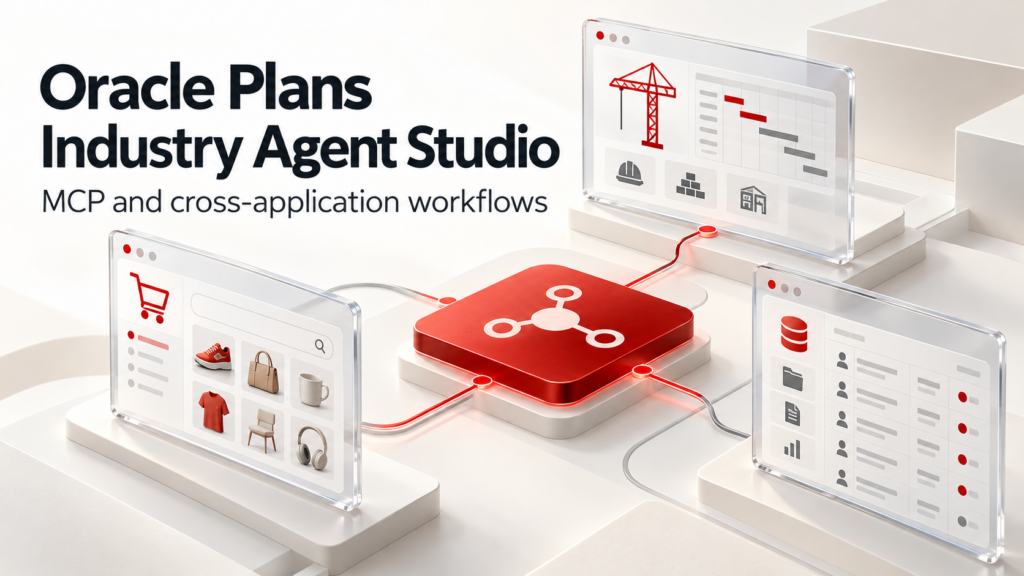
Oracle announced Oracle AI Agent Studio for Industry Applications on 21 October 2026, proposing a way for businesses to build agents around specialised operational workflows. The offering extends its Fusion agent-building approach into industry applications, with planned MCP support and coordination across supported Oracle systems.
Access remains a future milestone. The footnote in Oracle’s announcement says U.S. availability is planned within the next 12 months, followed by expansion to supported OCI Enterprise AI regions over time. That makes this a product announcement, with delivery still ahead.
What Oracle is proposing
Oracle describes a no-code and low-code environment with reusable industry components, natural-language instructions and visual workflow editing. Its examples include identifying construction schedule risks and adapting retail catalog workflows. These describe intended uses, rather than measured customer outcomes.
The product overview describes testing, execution traces, permissions and monitoring of AI-unit consumption. It also identifies eligible Oracle industry SaaS customers and partners as the intended users of a multitenant service.
For an operations team, the potential attraction is continuity: an agent could work with the application context already used to manage a business process. Whether that reduces implementation effort will depend on the particular application, supported actions and configuration required.
MCP connectivity and workflow orchestration do different jobs
Oracle says MCP servers will expose approved Industry Application tools for reuse. Separately, its orchestration capability is intended to coordinate supported agents, tools and services across Oracle Industry and Fusion Cloud Applications.
MCP, short for Model Context Protocol, provides a standard way for AI applications to discover and interact with capabilities exposed by servers. Those capabilities can include executable tools and contextual data. It does not, by itself, define an organisation’s entire business process.
That distinction matters when evaluating a proposed workflow. Connecting an agent to a tool answers how it can request an action. The surrounding workflow must still establish when that action is appropriate, what information it requires and who can authorise it.
Consider a hypothetical purchasing workflow: one step checks a request, another prepares a proposed order, and a manager approves the commitment. A connection to the purchasing system is only part of the job. The workflow also needs to preserve the approval boundary and report what happened if a later step fails.
Oracle’s announced scope should therefore be read at the level of supported applications and tools. It is not a promise that any third-party application can participate without additional integration work.
Cross-application work makes permissions more consequential
The product page says organisations can configure access and permitted actions, with identity and governed-access capabilities dependent on enabled services and integrations. These are design capabilities described by Oracle, not a guarantee that every customer configuration will be correct.
A useful evaluation would distinguish permission to read a record from permission to change it. An agent preparing a recommendation may need broad context while requiring very narrow authority to act.
The same distinction appears in Visa, BILL and Billtrust’s invoice-payment pilot, where agents execute authorised payments rather than choose which invoices should be paid. That separate deployment illustrates why buyers should ask precisely where decision-making authority sits.
For a workflow spanning applications, buyers should also test partial completion. If an initial action succeeds but a later one fails, can the team identify the completed change, avoid an accidental duplicate and route the exception to the right person? Those questions would make a trial more informative than a successful demonstration alone.
A rollout plan still needs customer-level detail
Oracle’s product FAQ uses present-tense availability language, while its dated announcement provides the explicit future rollout window. Customers considering adoption should obtain confirmation of access for their application and region before treating the offering as deployable.
Coverage from Investing.com and Unite.AI also describes the announcement. That coverage largely relays Oracle’s stated capabilities; it does not establish production reliability or savings through independent testing.
The commercial questions are equally specific. A buyer needs to know which workflows are supported, how usage is charged and what additional services are required. Monitoring consumption can help explain usage, but a meaningful comparison should measure the full cost of a correctly completed task, including retries and human review.
Oracle is proposing to make its existing application environment a place where customers build and coordinate industry agents. The next meaningful evidence will be delivery against the rollout plan, followed by customer results showing that those agents can complete bounded work reliably and at an acceptable cost.
Prepared with AI-assisted research and drafting.
About Puneet Sharma

Puneet Sharma · Freelance Writer
Puneet Sharma is a freelance writer covering AI agents, automation and the software changing how we work. His coverage at AgentsCalling starts with the questions a reader might ask over a conversation: What does this tool actually do? Where does it fall short? And is it useful beyond the demo? His articles explore new launches, practical workflows and the trade-offs behind giving software more responsibility, with explanations that make room for readers who are still getting familiar with AI.