Anthropic still lists Claude Opus 5.5 as its latest public Opus model. As of November 27, 2026, there’s no confirmed Claude Opus 5.6 release date, public API model ID or price. The name comes from people trying to explain unusually polished coding demos that appeared this week. The current lineup is in Anthropic’s model catalog.
My verdict at AgentsCalling is to keep Opus 5.5 in production. The demos made me want to see what Anthropic ships next. What would make me switch is a model that finishes more of our work without someone stepping in to fix a small, avoidable mistake halfway through.
The Opus 5.6 demos make a case for creative coding
The example I’d pay the most attention to is The Last Page, a 65-second short about a fox in a library. The creator published the prompt and Python project. The sequence asks for more than a good-looking still. Timing, lighting and movement across scenes all have to serve the same story. That’s a more revealing creative assignment than asking an agent to make a single striking image. See the creator’s project and prompt.
TestingCatalog reported that the creator attributed the run to a route labeled “Opus 5.5 Extra.” The label leaves the underlying model unresolved. The code gives us something to inspect and reproduce as a finished animation. To compare models, we’d also need to know which model generated the code and whether both runs used the same setup. See TestingCatalog’s reporting on the demos.
The public comparisons also point in different directions. Platin Digital found a comparison of the fox animation that used runs from different people. It also documented a Blender task where the run attributed to the newer model took longer, used more of the tester’s subscription quota and dropped a visual element that appeared in the earlier version. The tester was unsure which model ran it. I’d start an evaluation with creative coding, then repeat the same brief using the same tools and effort settings. See Platin Digital’s comparison roundup.
What I’d ask Opus 5.6 to do in Claude Code
My first test would be a CSV import change in an existing app. Give the agent a small repository, ask it to support a new date format and include a sample with a malformed row. The change passes if the new format imports, old files still work, the malformed row gets a clear error and the agent can show which tests actually ran. A small patch that passes all four checks is easy to review. A sweeping rewrite that leaves compatibility unverified shifts the work back to the developer.
I’d run each model from the same starting commit with the same tools, permissions and time budget. I’d repeat the task from a fresh session and make one test command time out once. Does the agent recover, retry it blindly or say the change is ready with a check still missing? A tool failure and a model mistake need different fixes. That distinction stood out in our coverage of ProbeAgent’s approach to diagnosing failures.

For a business workflow, I’d give the agent two sample invoices with the same total in different currencies and ask it to prepare a payment summary for approval. The agent should preserve the currencies, flag the missing exchange rate and leave payment execution with the reviewer. I’d capture that approval boundary in the task setup. A remembered permission can carry consequences into later runs, as we covered in our analysis of Claude Code’s approval files.
What a benchmark can tell us about longer jobs
One lesson I’d carry forward from METR’s November evaluations is to score work that has clear feedback separately from work that requires judgment. A code change can often be checked against expected behavior. An agent deciding whether ambiguous invoices refer to the same obligation needs to flag its uncertainty and show the documents that support its call. METR found that gaps in judgment were still visible on tasks where empirical feedback was slow or unclear. See METR’s November capability evaluation.
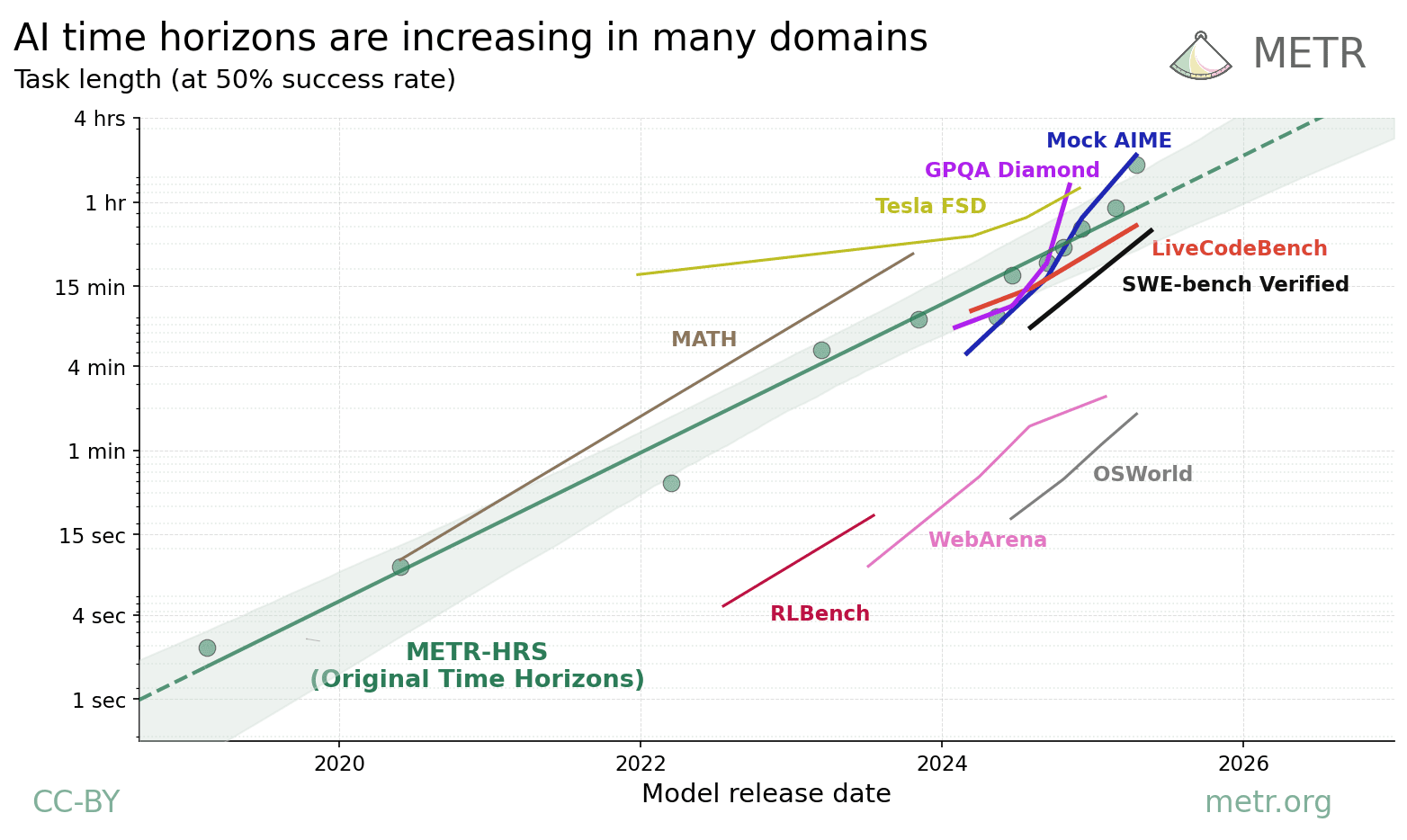
The chart shows why I’d keep the coding and invoice results separate. METR defines a time horizon using how long an expert would take on tasks at a given level of difficulty. It measures task difficulty for a given success rate. For an agent we’d actually deploy, I’d also record how often someone had to step in and how much time that person spent finishing the job. Read METR’s explanation of the time-horizon metric.
Opus 5.5 already gives teams a clear price to beat
These are the base Claude API rates for three confirmed models. The last column shows how I’d use each one in an evaluation. Subscription allowances, caching and fast-mode rates can change the economics of a real run. See Anthropic’s Opus pricing and availability details.
| Claude model | Input / 1M | Output / 1M | Where I’d start |
|---|---|---|---|
| Sonnet 5.5 | $2 | $10 | Routine tasks with a clear pass condition |
| Opus 5.5 | $4 | $20 | Multi-step coding and knowledge work |
| Fable 5.2 | $8 | $40 | Difficult jobs Opus 5.5 repeatedly fails |
If Opus 5.6 ships, I’d compare cost per accepted task. Add up model spend across attempts, including discarded runs, then divide by the number of outputs that pass review. Track human cleanup separately. If two agents each spend $20 across ten jobs and one gets eight accepted while the other gets five, they cost $2.50 and $4 per accepted job respectively. Those figures are illustrative. I care just as much whether the reviewer can approve the result in two minutes or needs twenty minutes to reconstruct what happened.
I’d also record the model identifier, effort setting, tool permissions and any fallback visible in the run. That makes it possible to investigate a change in results later. It matters especially for this rumor, where the identity of the model in the demos is the first point a team would need to verify.
The AgentsCalling verdict
I’d keep Opus 5.5 on work it already handles and try Fable 5.2 on a few jobs where the extra spend might save substantial rework. Once Anthropic releases a selectable successor, I’d give it the tasks our current setup fails most often. If it gets more of those jobs through review within a cost we can justify, I’d move those workflows first. That’s the upgrade I’d pay for.
Reporting note. Sources checked on November 27, 2026. This is AI-assisted editorial analysis of public reporting and documentation. AgentsCalling did not run Opus 5.6 or perform the proposed tests.
Disclosure: This article was edited by Puneet Sharma. For more information on how we create and review content, see our Editorial Policy.
About Puneet Sharma

Puneet Sharma · Freelance Writer
Puneet Sharma is a freelance writer covering AI agents, automation and the software changing how we work. His coverage at AgentsCalling starts with the questions a reader might ask over a conversation: What does this tool actually do? Where does it fall short? And is it useful beyond the demo? His articles explore new launches, practical workflows and the trade-offs behind giving software more responsibility, with explanations that make room for readers who are still getting familiar with AI.